now playing on my laptop: Nightmare by Halsey
Hello readers!
The second installment in my epic fantasy series Dragons Rising is available now! In Band of Breakers, Vahly explores the ruins of the old human civilization both in the mountains and under the sea.

And that’s where things get very interesting.
Vahly finally meets her familiar, a gryphon with remarkable powers.
Grab Band of Breakers today to find out what they can do together!
Warning! This book ends on a cliffhanger! I am so sorry, but it had to happen that way. The third book, Queen of Seas, will be available at the end of October if all goes well and I will have a cover reveal on that bad boy very soon, so be watching this space.

Want to read the first chapter of Band of Breakers? Here it is!
In the dead of night, the Lapis library was as silent as a tomb.
A high fever had struck Vahly down, and they’d been forced to stay with Amona for over a week. But the hallucinatory dreams and violent dizziness did nothing to dispel the strange urge inside Vahly, the bone-shaking urgency her magic thrummed through her body. With every heartbeat, her magic demanded that she travel to the western mountains. Now. Immediately. Before it was too late.
Too late for what? Vahly didn’t know.
The fever had abated, and the night of their departure was here.
Finally, Vahly could give in to that insistent drumming in her veins and rush toward the mystery of what her magic sought. She couldn’t leave fast enough to suit her.
Arc theorized that Vahly’s new magic had caused the fever, but it didn’t matter now. They had magic to follow and sea folk to overcome. And no one knew how much time they had left before the flooding started and the end began.
The western coast was such an odd destination, a place where humans had once flourished and now only sun-faded art, flooded streets, and castles eaten away by time remained. Her mother Amona had taken her there a long time ago—to the lands above the great city the Sea Queen had flooded in one of her first efforts to cover the world in water—but Vahly had been too young to process the gravity and history of the place. Vahly pressed a hand against her chest, the magic pushing, pushing, pushing. No, the fever didn’t matter and neither did the strange quest. It simply had to be done.
The silence in the Lapis caves dragged a distinctly creepy feeling down her spine. The library was always quiet, but not like this, not this deep sort of silence. Usually, a youngling wailed from somewhere inside the labyrinth of tunnels and rooms, and oftentimes, dragons of mating age would stay up late drinking and teasing one another.
But tonight—nothing.
She really hoped the grave-like stillness wasn’t an omen for their quest to see the scant ruins and caves above the sunken human city of Bihotzetik.
What if the fever had been a warning? A counterbalance to her need to get into the western mountains?
Exhaling her stress, she held up a lantern. The light painted Amona’s blue-scaled hands as the Lapis dragon matriarch pushed a bookshelf away from the northeastern wall of the library to reveal a round, wooden door in the rock wall, a brass knob glinting from its center.
The door squeaked open under Vahly’s hand. “I had no idea this was here.”
Amona donned a half-smile. “I’m allowed some secrets, Daughter. Listen, I’ll keep an ear to the ground and contact you if I hear of anyone following you or if any intend to harm you.”
Nix stood beside Arc, a pack slung over one shoulder and wing. The black of her pupils nearly overcame the bright yellow of her irises. “Why would anyone want to ruin the one chance we have against the Sea Queen?”
Arc had a scroll open on the table beyond the secret door. He probably hadn’t even noticed the door or Amona’s words. Absently tapping his bottom lip with his thumb, he squinted at what appeared to be a list of dragon herbal remedies, complete with colored drawings of green leaves, purple stems, and white blooms. As an elf with royal blood, his vision was exceptional, far better than Vahly’s or any dragon’s. The squinting and thumb tapping were simply his thinking pose.
Amona handed Vahly a bag of what smelled like fresh bread. Amona had insisted on seeing them off herself, with no one else around to preserve their lie that Vahly and the others were closeted in meetings about the coming war and her new powers. Amona had said none needed to know that Vahly’s earth magic was still rather limited. Fear would only complicate things and dampen the hope Vahly had given the dragons and their new allies, the elves.
“My kynd are not perfect,” Amona said in answer to Nix’s question about a possible attack. “No kynd can be. The Jade matriarch, Eux, informed me that not all of the Jades came to the swearing in Red Meadow.”
Vahly gripped the door handle. “What?”
Amona grimaced. “Eux believed all had come because of her command through the Call.”
Nix’s wings flicked in agitation as she tied her red hair into a knot on top of her head. “I made the announcement to all the Breakers at the ciderhouse. Euskal and Aitor spread the word. I don’t think we missed anyone. I did a head count during the oath. They were all gathered up beside Miren.”
Nix was right. Vahly had heard Euskal calling around when she’d been in Nix’s rooms, helping her pack up. And Aitor had ignored the fact that his face had been all but ruined by a Jade and had gone off gladly to round up any Jade Breakers who didn’t often come by Nix’s. He’d returned with a full list of those attending the oath. On the day they all swore allegiance to Vahly, every Breaker who had ever crossed Nix’s threshold—and many strangers as well—had stood near the bald-headed Miren.
Amona frowned at Arc, then looked back at Vahly, her eyes filled with concern. “Eux says there is a band of Breakers who keep far away from every other highbeast. They broke away years ago, and no one has seen them.”
“They’re probably dead.” Vahly walked over to Arc, then tugged on his surcoat. “Every time I turn my back on you, you’re trying to learn things. The reading will have to wait, my dear elf.”
A sly grin slid over Arc’s bow lips. “I don’t mind being called dear.”
Vahly’s heart thudded inside her chest. She chuckled at herself and shook her head.
“Vahly.” The matriarch’s voice held the sharp edge of a command, and Vahly found herself standing straight and listening intently. Their bonding was definitely still intact, and she was glad of it. It was almost as good as having Amona along on the journey. The security of knowing she had backup in the form of a matriarch was no small thing. Plus, the familiarity of her mother’s voice eased her fears about what she might be headed into and how she might very well turn out to be too weak to fight the Sea Queen. “I don’t think the Jade Breakers are dead. There are rams enough in the high mountains to feed a small group if they are smart about the way they hunt and manage the land.”
Nix sniffed. “I would strongly prefer it if we didn’t use the term Breakers for these miscreants.”
Vahly grinned. “Like our Breakers aren’t miscreants?”
Nix raised her chin haughtily. “My Breakers would never skip out on swearing allegiance to you, Earth Queen.”
Smoke twisted from Amona’s nostrils. “Only to me and to Eux, hm?”
Vahly held up a hand. “Let’s remember we’re all on the same side here. The past is the past. All right?” She dipped her head respectfully to Amona. “My matriarch?”
Amona let out a smoky breath, her gaze never leaving Nix. “You know, I put up with quite a bit from you and yours over the years. And you pulled my daughter into your schemes as well, even though she had no need for more gold.”
“I didn’t befriend her until she came to me, and by then, she was an adult, and she made her own decisions. With respect, Amona.” Nix deigned to bow her head briefly.
Amona lips parted like she was about to say something, but then she closed her mouth.
“Time to go?” Vahly raised her eyebrows and forced her voice to sound cheerful. “Yes, I think it is time to go. Goodbye, Mother and Matriarch.” She touched Amona’s forearm.
The heat left Amona’s gaze as she looked at Vahly. “I wish you safe travel. Be wary of the rogue Jades. They may not believe you are what we know you are, or they may simply kill without stopping to consider the consequences.”
“Sounds about right,” Vahly muttered.
“Call to me if you need aid,” Amona said.
“Stars and Blackwater, Arc, come on,” Vahly said, eyeing him as he replaced the scroll he’d been reading.
He joined her, and they started into the tunnel.
“Before these two light one another on fire,” she whispered to Arc, jerking her head in the direction of the dragons.
Nix gave Amona one last nod, then walked behind them. “I think you and the elf are more likely to ignite than anyone else.” She winked a large, yellow eye. One of her blue wings masked the side of her scaled, round-cheeked face.
Arc took the lead, allowing Nix and Vahly to walk side by side. The lantern’s light flickered over his form, casting his powerfully shaped shadow across the tunnel’s dry rock walls.
“Who would’ve guessed we’d be traveling with an elf?” Nix smirked.
“Not this lady,” Vahly said.
Dark and narrower than any of the tunnels in the Lapis dragon palace, the passageway twisted and turned under the earth like the belly of a petrified snake. Cool water dripped from the ceiling, gathering on Vahly’s head and in the crook of her arms.
Buzzing and drumming through her feet, earth magic urged Vahly’s legs to run, but she held back. This couldn’t be a rushed trip. It was a good hike to the western mountains, and hurrying overmuch wouldn’t do anything except wear her recently healed body out too soon.
In silence, they continued on as the tunnel began a slow ascent. Dim moonlight filtered in from the distance, showing spindly ferns and thick moss on the passageway’s walls. A mouse squeaked and hurried past, making Nix grunt in disapproval.
“They could’ve tidied up a bit for us. You are a queen, after all,” she muttered.
North of the main Lapis palace entrance, the tunnel opened into the Red Meadow. A crescent moon limned the flowers and the river, the sight forming a wish inside Vahly, a wish that they could stop here and enjoy the beauty instead of sneaking farther into the wilderness with no clue as to what they might find there.
Vahly’s nerves sparked. What if she was leading Nix and Arc on a wild ferret chase? One that led to a death by either thirst or rogue Jades?
Built by her ancestors, a crumbling stone bridge reached to the far side of the river. Arc went across first, the endless night sky making him look small, and Nix followed, the edges and hollows of her wings collecting starlight like jewel dust.
The small stones of the bridge crunched beneath Vahly’s boots. “I’m seriously worried I’m dragging you two into an unending nightmare.”
Nix snorted a laugh.
Arc turned, frowning. “I assure you, I’m fully awake. My nightmares involve a great deal more drama.”
“More drama than following a leader who has no idea where she’s going?” Vahly asked.
Arc glanced at her. “I know where we’re going.”
“I don’t mean the trail. I mean, I’m not at all sure about this whole follow-my-gut thing.”
Nix’s wing brushed her arm. “What are our other choices? You don’t have your full powers yet. We need to wake your magic completely or we have no chance against the Sea Queen.”
“Indeed,” Arc said quietly.
Nix spread her hands. “And anyway, I was bored.”
Vahly rolled her eyes. This bravado was a mask. Nix just didn’t want to stay around the ciderhouse where the imaginary ghosts of Dramour, Kemen, and Ibai haunted every corner. Nix needed time away. So did Vahly. Their loss was an avalanche waiting to start. If the details of whom they had lost crept into her immediate thoughts, if she indulged in any intimate memories, the whole mountain of grief would bury her. She simply could not think of Dramour’s laugh, Kemen’s conspiratorial nod, or Ibai’s intense gaze as he mixed potions for healing.
Her eyes burned with hidden emotion as they came to the end of the bridge. She could almost hear her heart cracking, preparing for a life-altering fall. She cleared her throat of the thickness that had gathered there.
“But how long do we give this?” she asked.
Arc stopped to move his bow to his other shoulder while Nix and Vahly stood by the rippling water.
“What if we wander for an entire year?” Vahly asked. “An entire lifetime?”
Nix raised the scales above her eyes. “We’ll be dead by the Sea Queen’s hands long before any of that. Remember?”
Vahly crossed her arms. “Your bedside manner used to be much better.”
Nix opened her mouth to say something, but the water churned at their feet.
Heart beating a tattoo on her chest, Vahly stepped back and hauled Nix with her.
Could the sea folk have somehow reached this fresh water?
A shimmering light like a blurred moon rose from the silver-tipped ripples. A voice tripped through the air, a singing, notes warbling and numbing Vahly’s senses.
Shaking herself, Vahly stepped between the light and her friends.
“Be not afraid,” the light said, the sound reminiscent of wind chimes.
Arc knelt beside Nix.
“What are you doing?” Vahly drew her sword as Nix growled at the being.
Head bent, Arc spoke quietly. “Earth Queen, Mistress of the Call Breakers, I present to you the Spirit of the River.”
Vahly and Nix exchanged confused looks.
Vahly narrowed her eyes at the Spirit, trusting that Arc was not simply acting gullible. “A pleasure to meet you.” She copied Arc and knelt in the sandy rocks beside the river’s edge.
Nix took a knee as well. “Just how many secrets are you keeping, elf?” she hissed out of the corner of her mouth.
The Spirit rose higher in the water. Silver scales glittered around the edges of the Spirit’s circular form. Vahly’s breath caught at the beauty and strangeness.
“Don’t fault the elven lord,” the Spirit whispered, the words dropping slowly like honey from a summer comb. “Of the sparing few who know of me, I ask that they hold talk of my existence to themselves.”
“With all respect,” Vahly started, “why do you now present yourself to us?”
“The world needs you, Earth Queen, and I must do my part to aid you on your journey.”
Vahly glanced at Nix, who shrugged. “Thank you. How exactly can you help?”
The Spirit dipped beneath the water for a moment, and a small wave lipped over the rocks to wet the toes of Vahly’s boot. “I am no warrior, but I helped your kynd build this bridge, and I came to love them.”
Images flickered to life at the far side of the bridge. Vahly stared in wonder as the ghostly shapes of humans accepted smoothed stones from a light that brought them to the surface—the Spirit was aiding them. There were at least a dozen humans, no, more than that. Males wearing hooded tunics digging a trench for drainage and laughing—the sound muffled and distant. Females with light hair like Vahly’s stacking rocks and creating short walls. Youths shoving one another into the river playfully and bearing the lectures of their elders.
Vahly put a hand to her cheek and realized she’d been crying. She wiped the tears away quickly, cheeks hot and her heart aching like a starving stomach.
The faint images faded, and Vahly battled the desire to run after them, to beg the Spirit to show them more.
Not noticing Vahly’s secret longings, the Spirit spoke on. “When Astraea rose to power in the salt water realms, her aura tainted even my waters. Indeed, her foul ocean blacked my fresh currents during the flooding that took the last of your family, Earth Queen.”
The Spirit spoke the Sea Queen’s name like a curse. Vahly was with her on that sentiment.
Silver light surrounded a river rock deep under the current, then the Spirit seemed to lift it above the water. “Take this. When you need aid, press a kiss onto its surface, and I will do my best to rally the creatures of fresh water to your banner.”
Vahly took the rock and grasped it tightly. The damp surface chilled her fingers, and the scent of algae and metal found her nose. What would it look like if this being rallied its creatures? Water snakes, spotted frogs, and salamanders racing over land to join Vahly at the coast?
A new thought sprang to mind, a child of the first.
What if Vahly could call up the creatures of the land? Was that already within her power? If so, she had no idea how to do it. Swallowing, she rose from her knee and stepped forward.
“Thank you, Spirit. May I ask how you summon your creatures? Is that something an Earth Queen should be able to do?”
The Spirit tipped to one side before righting itself. “I don’t have the knowledge of what an Earth Queen can or cannot do.”
Vahly frowned, disappointment tugging at her like a deep fatigue. “Oh. Of course. Thank you for the gift.”
Nodding once, the shimmering light lowered itself under the river’s dancing surface. With a splash, it was gone, and Vahly was left with the uncomfortable knowledge that there was so much more to learn about the world she was meant to save. And yes, some discoveries might prove beneficial like this river being and this special rock, but other revelations would hold threats she hadn’t prepared for, evils lurking unseen.
If she didn’t figure out how to wake her magic in full soon, what she didn’t know might kill her before the sea had its chance.


 Just that old woman scratching symbols into the dirt brings about ninety stories into your head, doesn’t it? And that woman clutching the totem/carved image? A+ stuff right there. You can also search terms like “folk magic” and see what the world thinks about those words visually. That sort of search always spawns ideas. Here is a peek at my board for The Matchweaver’s Loom (will be in the Once Upon An Enchanted Forest anthology in September and will kick off a new series for 2020).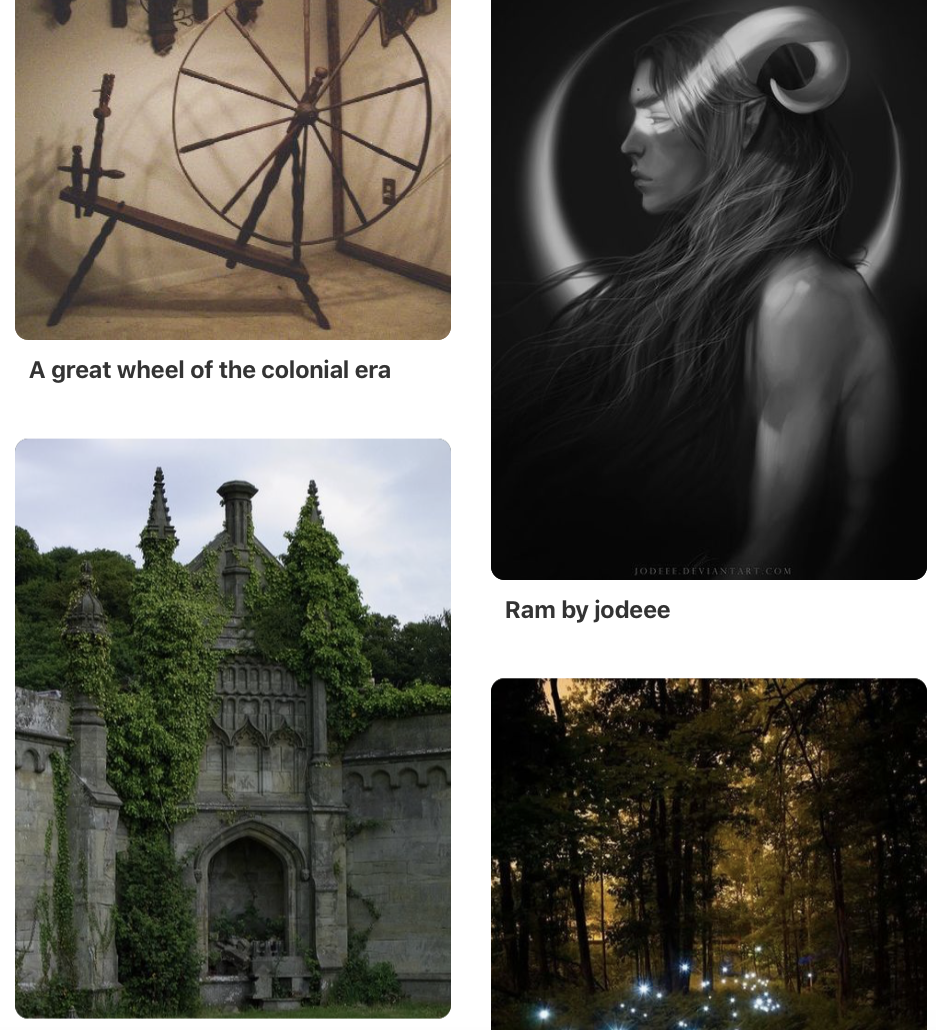





 I Heart Words